How to crochet straight edges
Crochet edges that lean, grow wider, or become uneven can make a project look frustratingly crooked. The good news is that straight crochet edges usually come down to a few simple habits.
In this guide, I’ll show you how to crochet straight edges, keep your stitch count consistent, and avoid common turning-chain mistakes. These tips work well for blankets, scarves, dishcloths, and other projects made in rows.
Quick answer
To keep crochet edges straight, count your stitches at the end of every row and make sure you work into the correct first and last stitch. Decide whether your turning chain counts as a stitch, then follow that rule consistently throughout the project.
Stitch markers can help you identify the edge stitches until you become comfortable finding them on your own.
Why crochet edges become uneven
Crochet edges usually become uneven when stitches are accidentally added or skipped. Even one missing or extra stitch in each row can quickly make your project wider, narrower, or slanted.
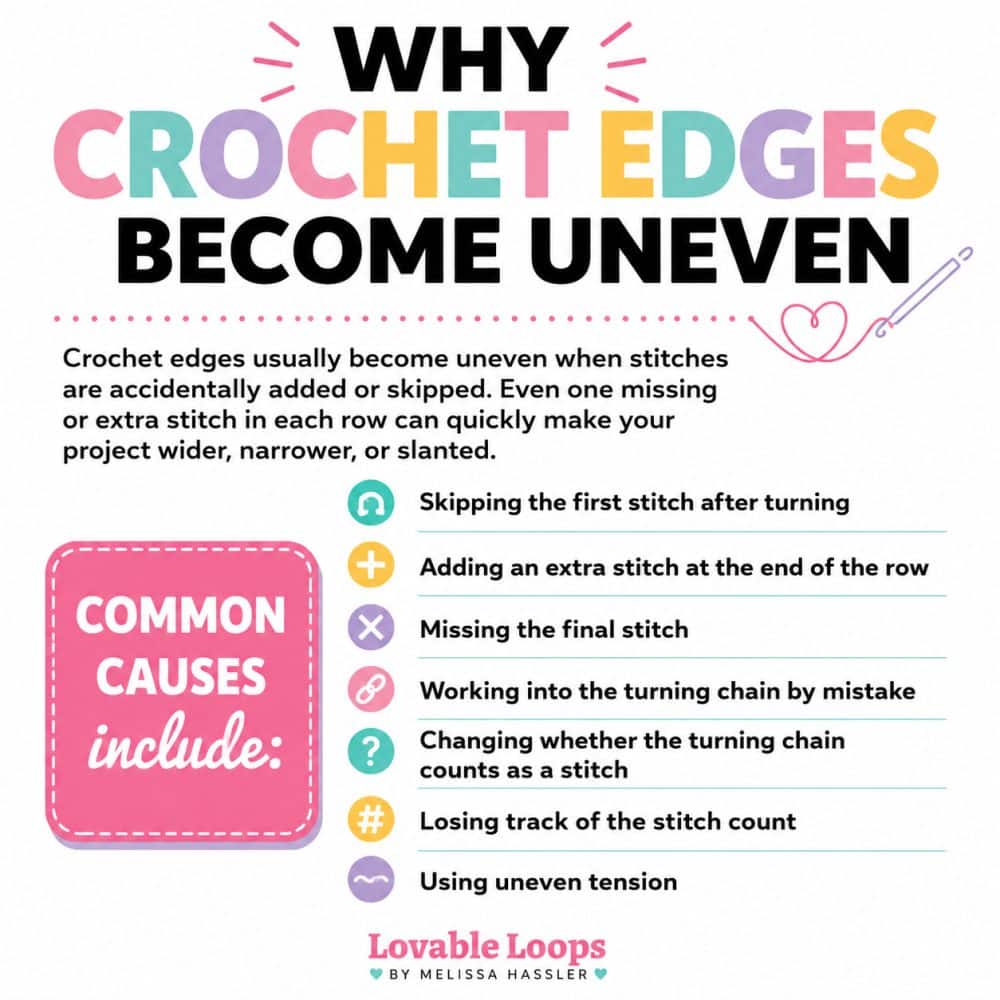
Common causes include:
- Skipping the first stitch after turning
- Adding an extra stitch at the end of the row
- Missing the final stitch
- Working into the turning chain by mistake
- Changing whether the turning chain counts as a stitch
- Losing track of the stitch count
- Using uneven tension
If you are still learning how to identify and count your stitches, my how to count crochet stitches tutorial can help.
Why straight crochet edges matter
Straight edges help your finished project look neat and polished. They are especially important when making blankets, scarves, dishcloths, garments, and crochet squares.
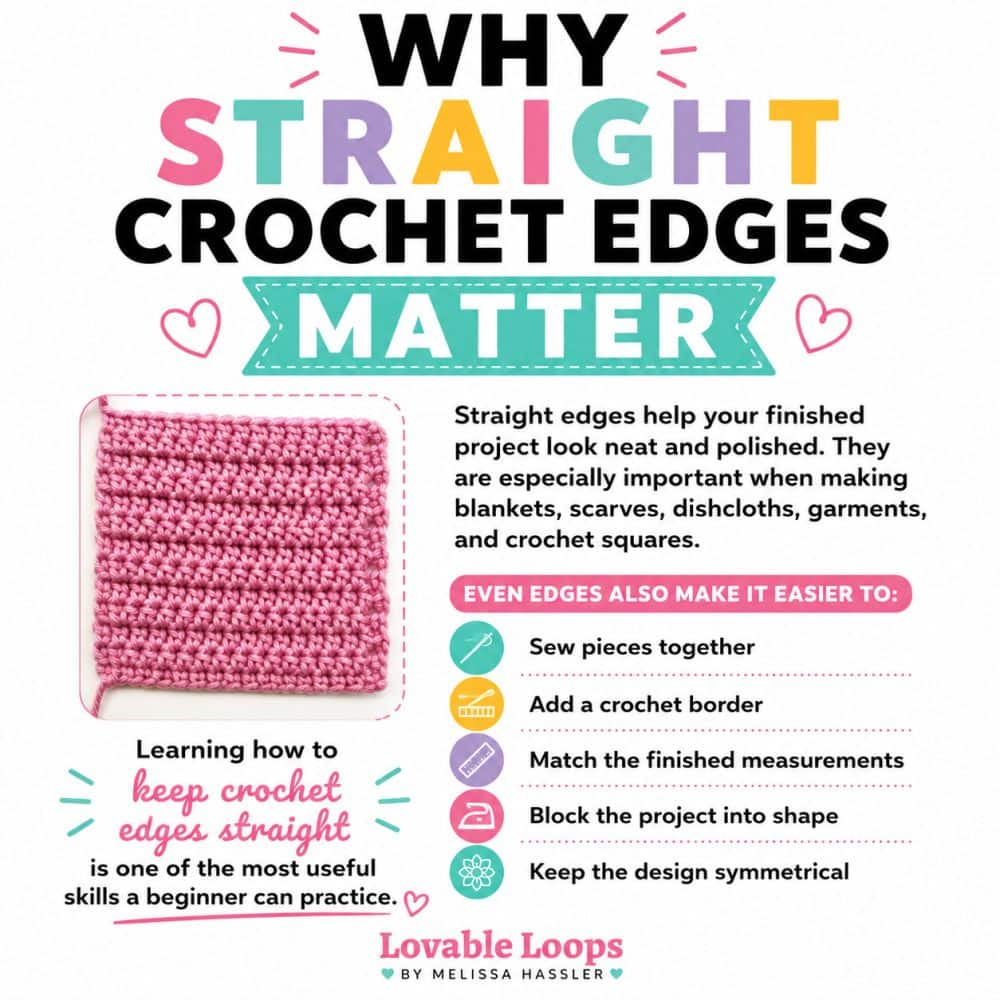
Even edges also make it easier to:
- Sew pieces together
- Add a crochet border
- Match the intended finished measurements
- Block the project into shape
- Keep the design symmetrical
Learning how to keep crochet edges straight is one of the most useful skills a beginner can practice.
7 tips for straight crochet edges
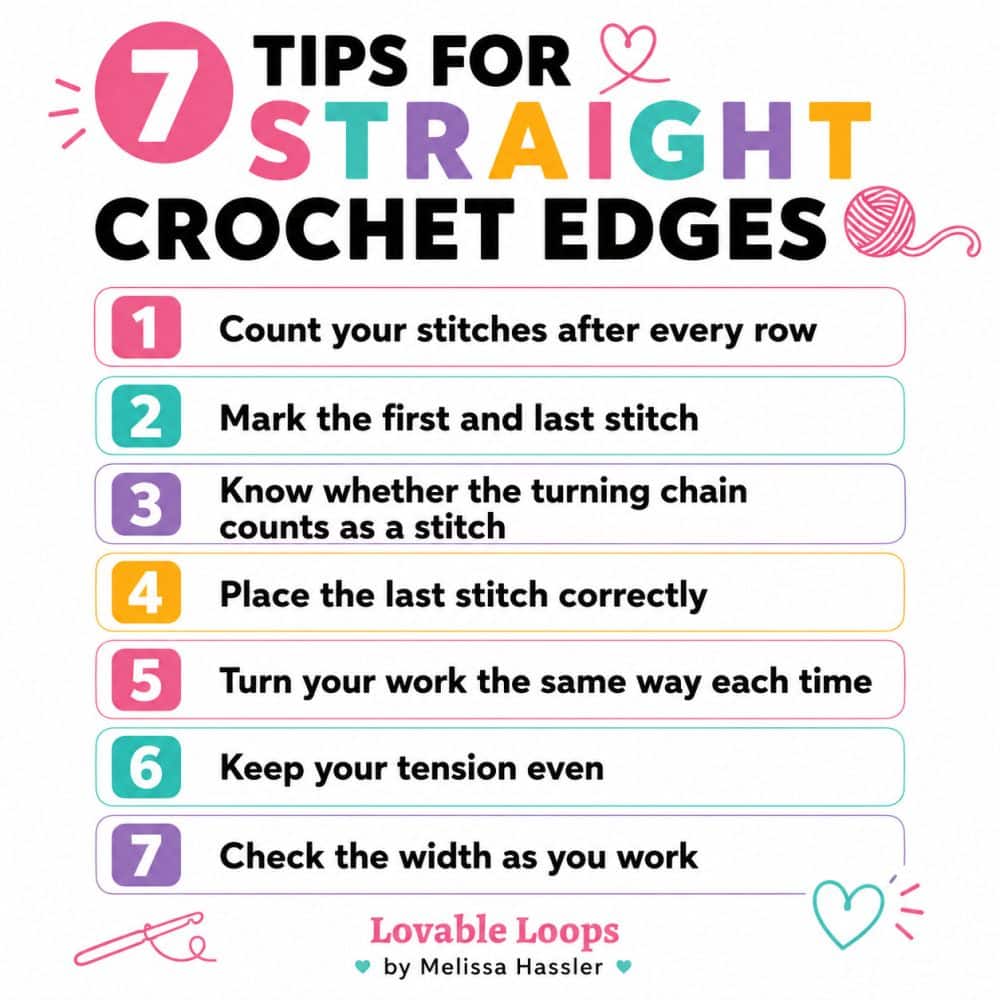
1. Count your stitches after every row
The easiest way to prevent uneven crochet edges is to count your stitches at the end of every row.
If the pattern says each row should have 40 stitches, make sure you still have 40 before moving on. Fixing a mistake right away is much easier than discovering it several rows later.
You do not have to count every stitch one at a time if the row is very long. Place stitch markers every 10 or 20 stitches to divide the row into smaller sections.
2. Mark the first and last stitch
The first and last stitches are easy to miss, especially when working with taller stitches such as half double crochet or double crochet.
Place a stitch marker in the first stitch as soon as you make it. You can also mark the last stitch before turning.
These markers show you exactly where the next row begins and ends.
3. Know whether the turning chain counts as a stitch
One of the most common causes of uneven crochet edges is confusion about the turning chain.
Some patterns count the turning chain as the first stitch. Other patterns do not.
Always read the pattern notes before you begin. Once you know the rule, follow it consistently for every row.
When the turning chain does not count as a stitch, work the first stitch into the first stitch of the row.
When the turning chain does count as a stitch, skip the first stitch and work the final stitch into the top of the turning chain from the previous row.
4. Place the last stitch correctly
The final stitch can be difficult to see because it often sits close to the turning chain.
Before finishing the row, spread the stitches apart and look carefully at the edge. A stitch marker placed in the first stitch of the previous row makes the final stitch much easier to find.
If you skip the last stitch repeatedly, your crochet project will slowly become narrower.
If you work an extra stitch into the turning chain, the project will slowly become wider.
5. Turn your work the same way each time
Turning your work in the same direction can help your edges look more consistent.
After completing a row, turn the project in the same direction before making the next turning chain. This helps keep the yarn and edge stitches positioned the same way from row to row.
The direction you choose is less important than being consistent.
6. Keep your tension even
Very tight stitches can pull the edges inward. Loose stitches can make the edges stretch or flare.
Try to hold the yarn with the same amount of tension throughout the row, including the first and last stitches.
If your stitches regularly feel too tight or too loose, changing the crochet hook size may help. My crochet hook sizes guide explains how hook size affects stitch size and tension.
7. Check the width as you work
Lay your project flat every few rows and check both edges.
Do not wait until the project is finished to look at the shape. Early checks make it easier to spot:
- Widening rows
- Narrowing rows
- Slanted sides
- Missed stitches
- Extra stitches
You can also measure the width in several places. The measurements should stay consistent unless the pattern includes intentional increases or decreases.
How to crochet a straight edge in single crochet
Single crochet stitches are short and compact, which usually makes the first and last stitches easier to see.
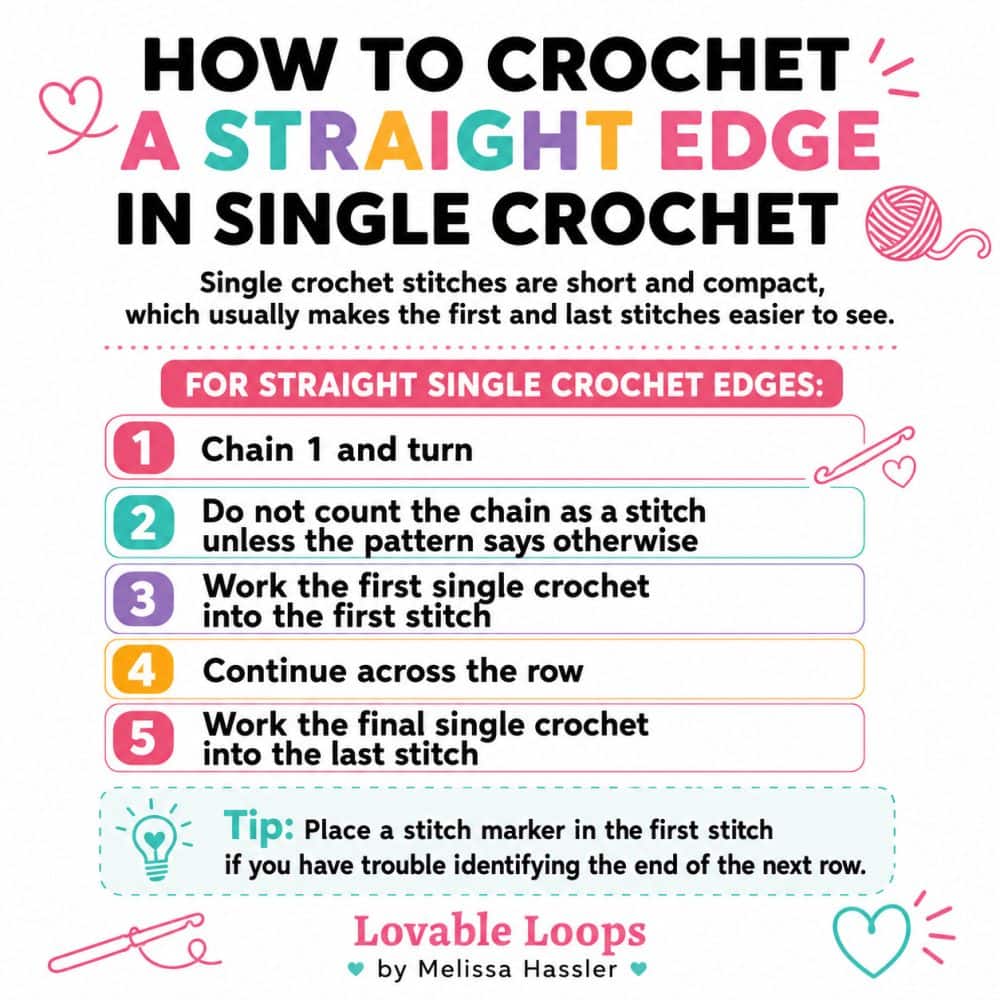
For straight single crochet edges:
- Chain 1 and turn.
- Do not count the chain as a stitch unless the pattern says otherwise.
- Work the first single crochet into the first stitch.
- Continue across the row.
- Work the final single crochet into the last stitch.
Place a stitch marker in the first stitch if you have trouble identifying the end of the next row.
New to this stitch? My how to single crochet tutorial includes step-by-step instructions and helpful photos.
How to crochet straight edges in half double crochet
Half double crochet stitches can make the edge stitches look slightly crowded.
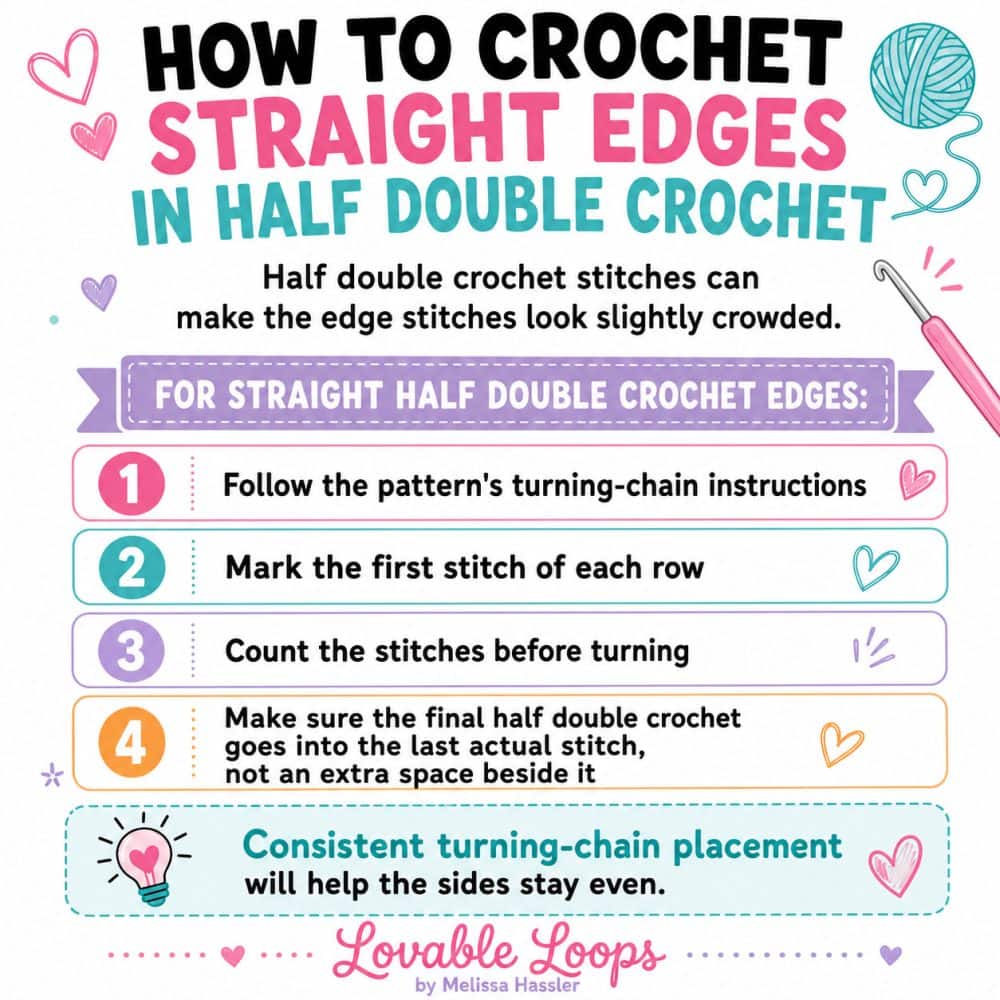
For straight half double crochet edges:
- Follow the pattern’s turning-chain instructions.
- Mark the first stitch of each row.
- Count the stitches before turning.
- Make sure the final half double crochet goes into the last actual stitch, not an extra space beside it.
Consistent turning-chain placement will help the sides stay even.
Need a refresher? My how to half double crochet tutorial walks you through the stitch step by step.
How to keep straight edges in double crochet
Double crochet edges can be more challenging because the turning chain is taller and may look like a stitch.
Start by deciding whether the turning chain counts as a stitch.
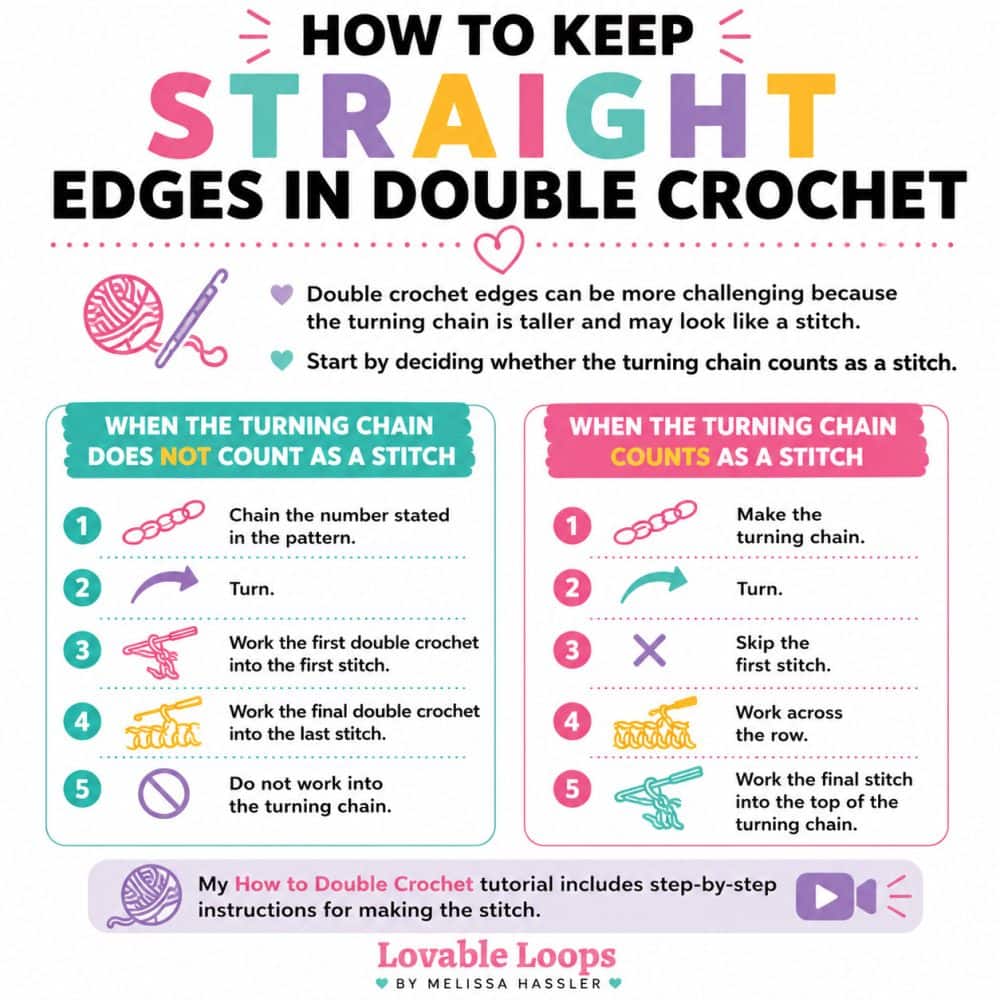
When the turning chain does not count as a stitch
- Chain the number stated in the pattern.
- Turn.
- Work the first double crochet into the first stitch.
- Work the final double crochet into the last stitch.
- Do not work into the turning chain.
When the turning chain counts as a stitch
- Make the turning chain.
- Turn.
- Skip the first stitch.
- Work across the row.
- Work the final stitch into the top of the turning chain.
My how to double crochet tutorial includes step-by-step instructions for making the stitch.
How to make straight edges on crochet blankets
Straight edges are especially important when making crochet blankets because small stitch-count errors become more noticeable over many rows.
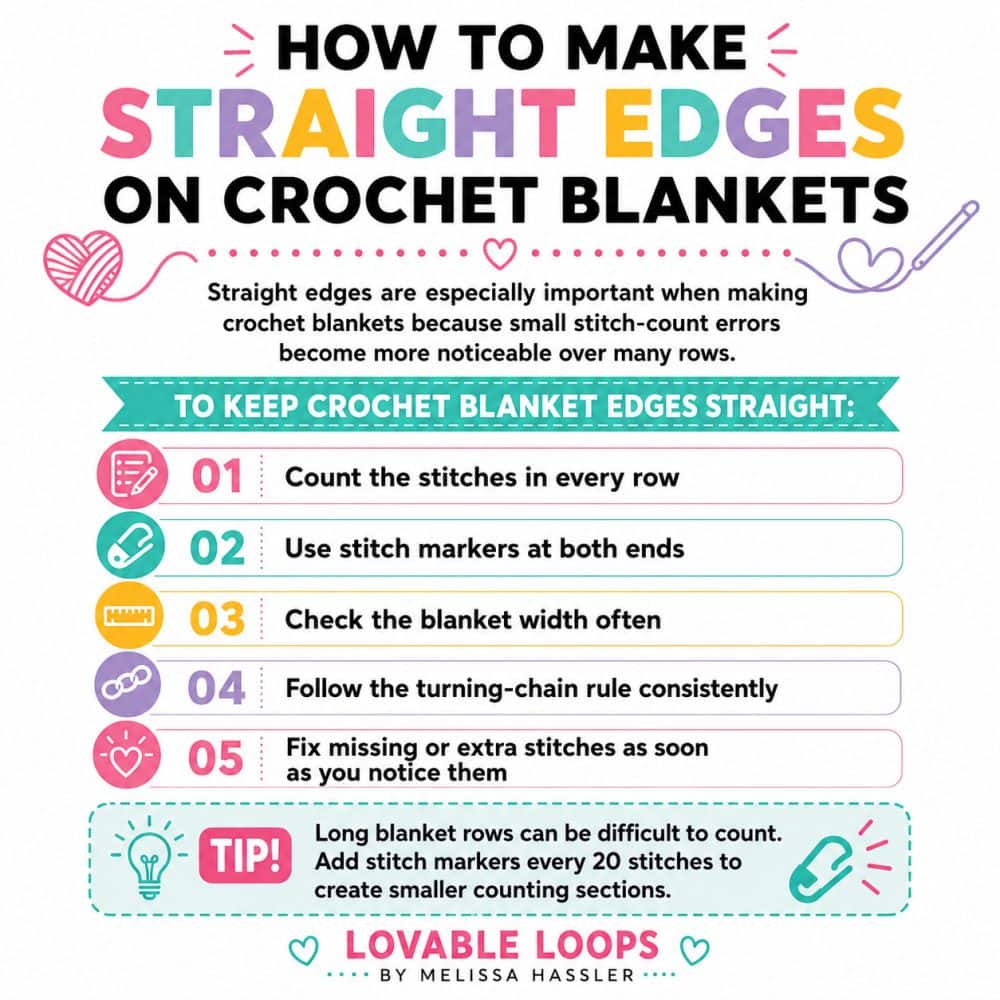
To keep crochet blanket edges straight:
- Count the stitches in every row
- Use stitch markers at both ends
- Check the blanket width often
- Follow the turning-chain rule consistently
- Fix missing or extra stitches as soon as you notice them
Long blanket rows can be difficult to count. Add stitch markers every 10 or 20 stitches to create smaller counting sections.
If you are planning a new blanket, my crochet blanket sizes guide can help you choose the right finished dimensions.
You can also browse my free crochet blanket patterns for more projects worked in rows.
Why are my crochet edges getting wider?
Crochet edges usually get wider because extra stitches are being added.
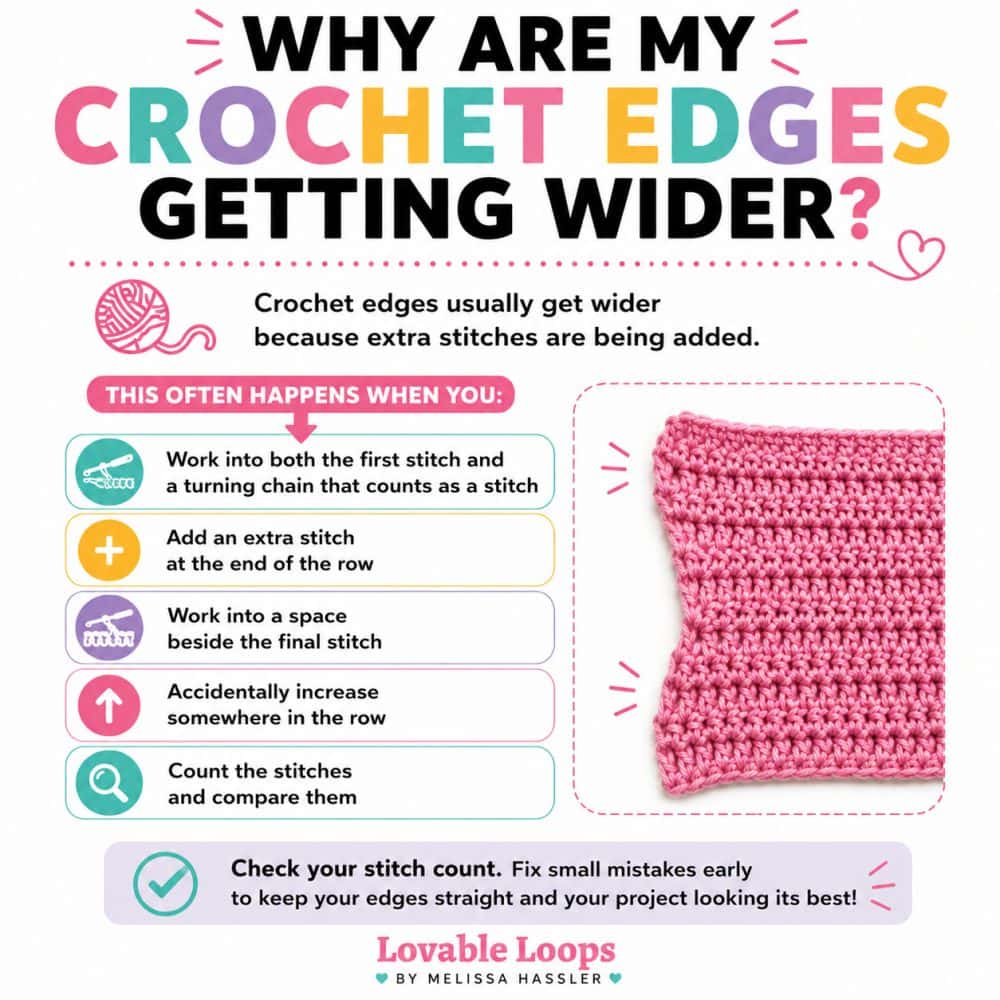
This often happens when you:
- Work into both the first stitch and a turning chain that counts as a stitch
- Add an extra stitch at the end of the row
- Work into a space beside the final stitch
- Accidentally increase somewhere in the row
Count the stitches and compare the total with the pattern. Use stitch markers to clearly identify the first and last stitches.
Why are my crochet edges getting narrower?
Crochet edges usually become narrower when stitches are skipped.
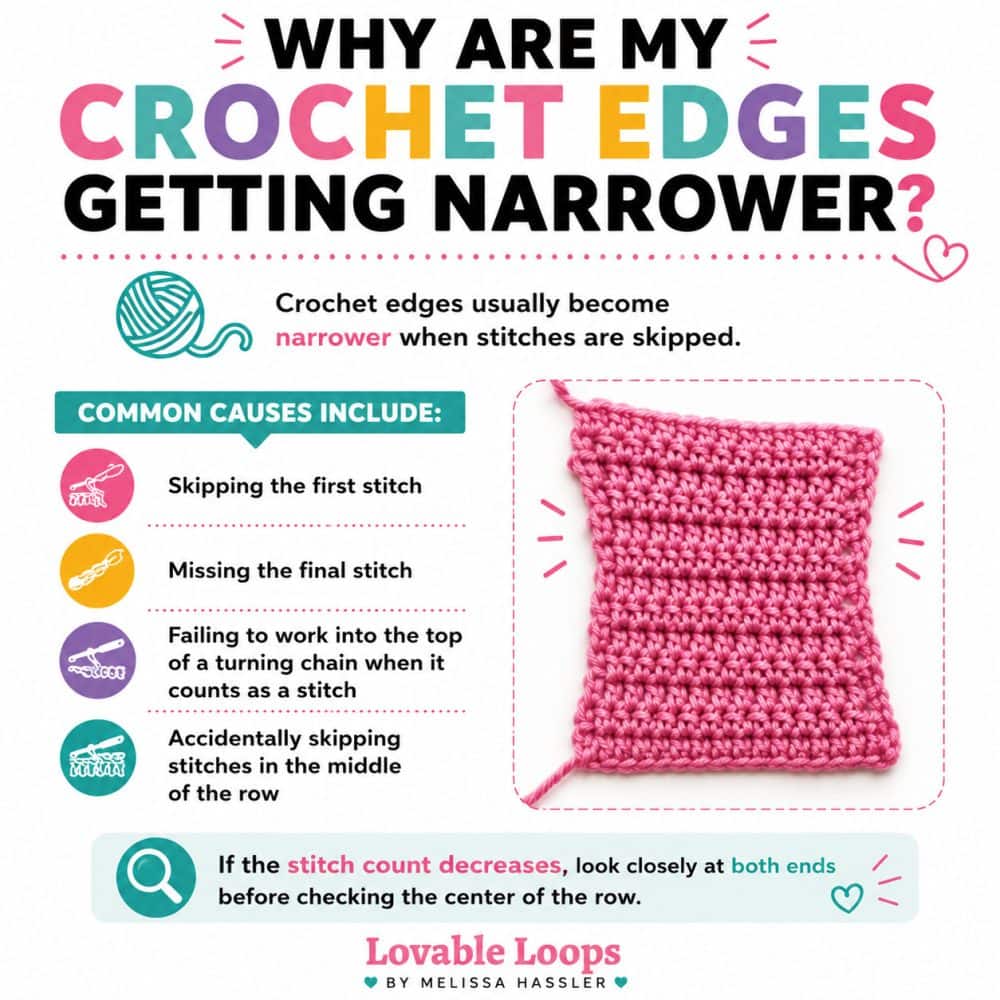
Common causes include:
- Skipping the first stitch
- Missing the final stitch
- Failing to work into the top of a turning chain when it counts as a stitch
- Accidentally skipping stitches in the middle of the row
If the stitch count decreases, look closely at both ends before checking the center of the row.
Why is my crochet edge slanted?
A crochet edge may slant when stitches are repeatedly added on one side or skipped on the other.
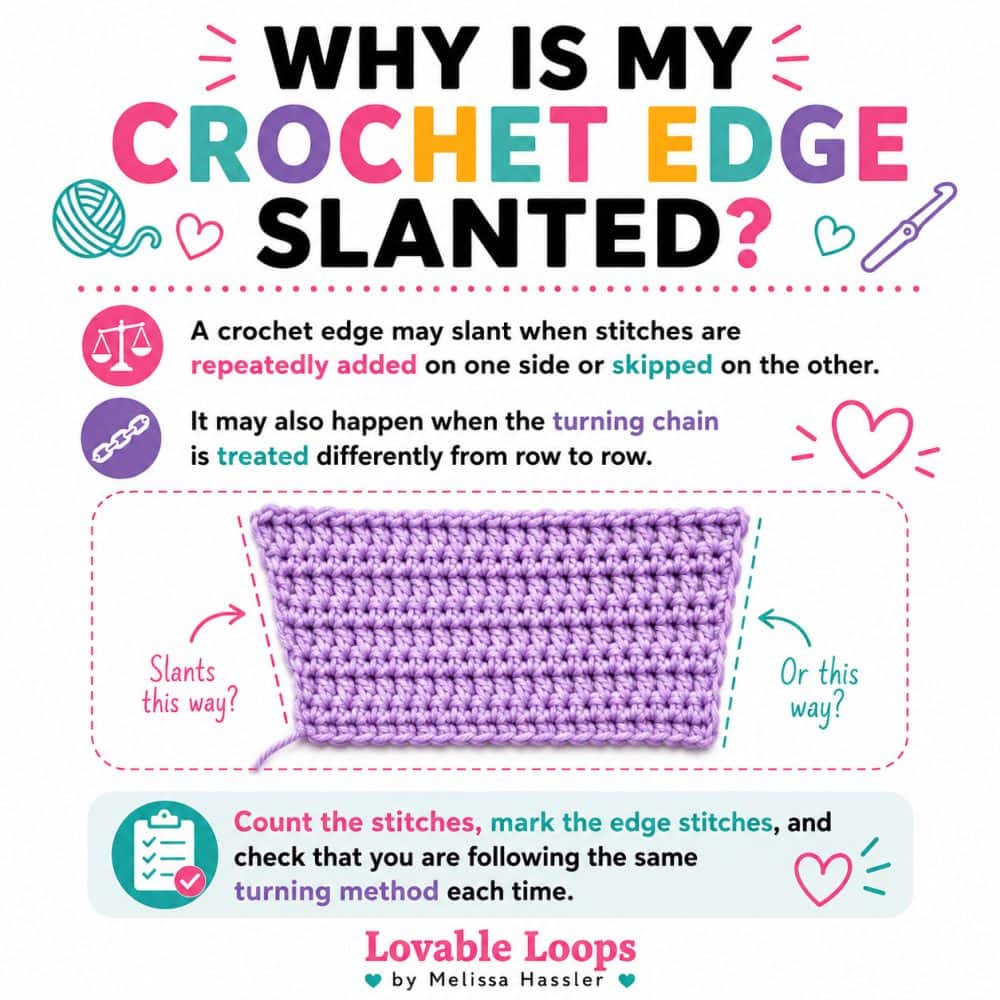
It may also happen when the turning chain is treated differently from row to row.
Count the stitches, mark the edge stitches, and check that you are following the same turning method each time.
How to fix uneven crochet edges
The best fix depends on how uneven the edges are.
Fixing a recent mistake
When you notice a missed or extra stitch within the last few rows, unravel the work to the mistake and crochet those rows again.
This usually gives the cleanest result.
Fixing a slightly uneven edge
A simple crochet border may help smooth small differences along the sides.
Begin with a foundation round of evenly spaced single crochet. Adjust the spacing slightly where needed to create a straighter edge.
My How to Crochet a Scalloped Edge tutorial is one decorative border option, but add the foundation round first so the scallops have an even base.
Fixing a very uneven edge
A border cannot fully hide large increases, decreases, or strongly slanted sides.
When the shape is noticeably uneven, unraveling to the problem row is usually the best choice.
Tips for neater row ends
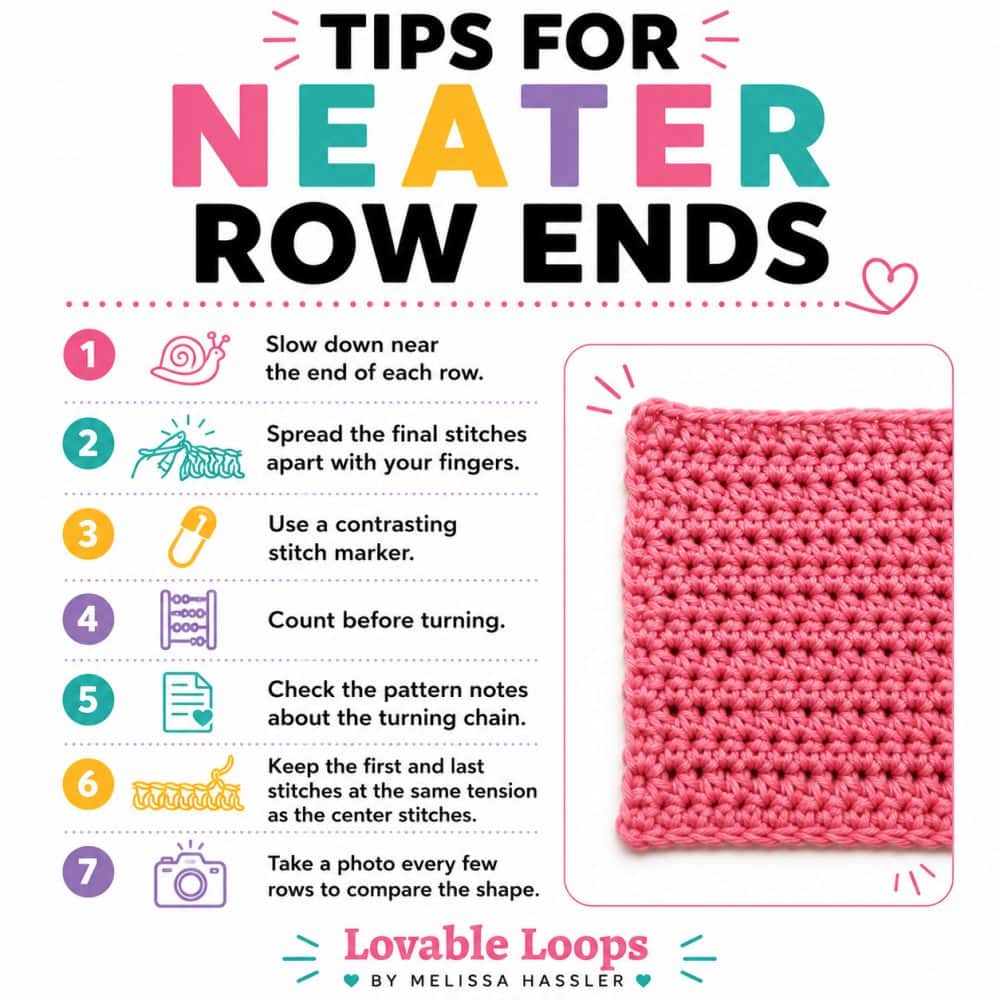
- Slow down near the end of each row.
- Spread the final stitches apart with your fingers.
- Use a contrasting stitch marker.
- Count before turning.
- Check the pattern notes about the turning chain.
- Keep the first and last stitches at the same tension as the center stitches.
- Take a photo every few rows to compare the shape.
Frequently asked questions
How do I keep my crochet edges straight?
Count your stitches at the end of each row, mark the first and last stitches, and follow the same turning-chain rule throughout the project.
Why are my crochet edges uneven?
Uneven edges are usually caused by adding or skipping stitches, working into the wrong edge stitch, or treating the turning chain inconsistently.
Why is my crochet getting wider?
Your project is likely gaining stitches. Check whether you are accidentally working into both the first stitch and a turning chain that already counts as a stitch.
Why is my crochet getting narrower?
Your project is likely losing stitches. Make sure you are working into the first and final stitch of every row.
Should the turning chain count as a stitch?
It depends on the pattern. Some patterns count it as a stitch, while others do not. Check the pattern notes and follow the same rule for every row.
How do I keep straight edges in double crochet?
Mark the first stitch, count every row, and be consistent about whether the turning chain counts as a stitch. Pay close attention to the final stitch because it can be difficult to see.
Can I fix uneven crochet edges with a border?
A border can improve slightly uneven edges, but it cannot fully correct severe increases, decreases, or slanted sides. For major mistakes, unraveling to the problem row usually gives the best result.
How do I keep crochet blanket edges straight?
Use stitch markers at both ends, count the stitches in every row, and measure the blanket width regularly. Long blanket rows are easier to count when divided into smaller sections with markers.
More crochet help for beginners
Building good crochet habits early can prevent many common mistakes. Browse my Learn Crochet page for more beginner tutorials, stitch guides, sizing help, and troubleshooting tips.
Let’s connect!
I’d love to see what you’re making! Share your finished project and follow along for more free crochet patterns and tutorials.
📌 Don’t forget to pin this pattern for later!
Happy crocheting! 🧶
— Melissa